

You've probably noticed it. One nonprofit hosts a food drive on the same Saturday another runs a clothing giveaway three blocks away. A family in need gets help from two organizations, while a family on the next street gets none. Three different agencies are tutoring kids at the same school, but no one is helping the seniors a mile down the road. The problem isn't a lack of good people doing good work in Amarillo. It's that too much of that work happens in silos. When non-profits coordinate, every dollar stretches further, every volunteer hour counts more, and fewer neighbors slip through the cracks.
This post breaks down why coordination is Amarillo's biggest missed opportunity, where the gaps show up, and how a stronger community impact organization in Amarillo can pull everyone in the same direction.
The Real Cost of Working in Silos
When non-profits operate independently without talking to each other, the same problems get solved twice while other problems go untouched. A single mother in Amarillo might receive rent help from one agency, food from another, and utility assistance from a third, but no one is connecting those dots to help her build long-term stability. Meanwhile, the family across town who needs all three never finds any of them.
Duplication wastes money. Two organizations buying the same software, renting separate warehouses, and running parallel intake systems eat up funding that could go directly to programs. Decades of research on cross-sector coordination show that large-scale social change rarely comes from isolated interventions by individual organizations, no matter how well-funded.
Where Coordination Breaks Down in Amarillo
Coordination gaps in Amarillo show up in predictable places. Spotting them is the first step to fixing them.
Overlapping Services in High-Visibility Areas
Downtown Amarillo and a few well-known neighborhoods get heavy nonprofit attention. Multiple food pantries, multiple after-school programs, multiple holiday gift drives. Meanwhile, parts of north and east Amarillo see far less consistent support, even though the need is just as real.
Disconnected Data Systems
If your nonprofit doesn't know which families another nonprofit is already serving, you can't refer effectively, track outcomes, or measure community-wide progress. Most local agencies still rely on their own spreadsheets, which means the bigger picture stays invisible.
Competing Fundraising Calendars
When five organizations all run their major fundraiser the same week in November, donors get fatigued and nonprofits get less. A coordinated calendar lets every agency get its fair share of attention and funding.
Volunteer Pipeline Confusion
Someone who wants to help in Amarillo often doesn't know where to start. They sign up with one organization, get one shift, and never get matched to the cause that actually fits them. A coordinated volunteer hub keeps that energy in the system.
What a Strong Community Impact Organization in Amarillo Actually Does
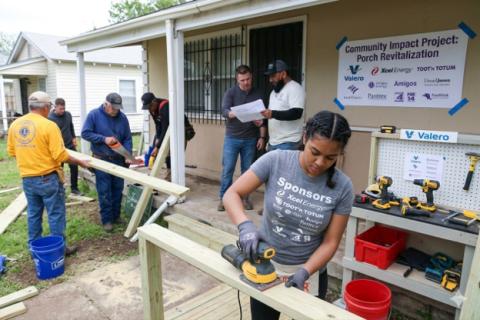
A community impact organization isn't just another non-profit. It's the connector. The role is less about running programs and more about making sure every program runs better together. Researchers call this a backbone organization, and it's the missing piece in most fragmented non-profit systems.
Here's what real coordination looks like in practice:
Shared needs assessments. One unified study of what Amarillo actually needs, updated regularly, so every agency works from the same map.
Funding alignment. Coordinated grant strategies that direct dollars where they matter most instead of where applications happen to land.
Referral networks. A warm handoff system so a family that walks into one agency gets connected to every other resource they qualify for.
Outcome tracking. Shared metrics that show whether Amarillo is actually moving the needle on hunger, housing, education, and financial stability.
Volunteer matching. A central place where willing hands get pointed to the highest-impact opportunities.
This is the role United Way of Amarillo & Canyon plays in the Panhandle, pulling community support programs in Amarillo into a connected system instead of letting them operate as isolated efforts.
How Better Coordination Grows Community Investment in Amarillo
Donors, foundations, and corporate funders pay attention to coordination. When a city can show measurable, collective progress on the issues that matter, community investment in Amarillo grows. Funders increasingly direct money to philanthropic collaboratives that pool resources across multiple agencies, because those vehicles produce more measurable impact than scattered single-program grants.
Coordination also unlocks bigger funding sources. Federal grants and large foundation gifts often require collaborative applications across multiple agencies. Cities that have aligned non-profit networks consistently pull in more outside money than cities that don't.
For the everyday donor, coordination means your $50 goes to a system that uses it wisely instead of duplicating a service three blocks away.
What You Can Do Right Now
Coordination doesn't only happen at the leadership level. You can push it forward as a resident, donor, or volunteer:
- Ask before you give. When donating, ask the organization who they partner with locally. Strong answers mean strong networks.
- Support coordinated giving. Donating through a community impact organization in Amarillo spreads your gift across vetted, complementary programs.
- Volunteer through a hub. Sign up through a centralized opportunity board instead of guessing which agency needs you most.
- Talk to other supporters. When neighbors compare notes on the causes they support, coordination follows naturally.
Your Next Step
Amarillo doesn't need more non-profits. It needs the ones already here to work as a team. That's how community support programs grow stronger, how community investment scales, and how real, lasting change shows up on every street, not just the visible ones. Support coordinated community impact in Amarillo today.
Frequently Asked Questions
What is a community impact organization in Amarillo?
A community impact organization is a nonprofit that coordinates other nonprofits, funders, and volunteers around shared goals. Instead of running one program, it helps the entire local nonprofit system work better together so more people get help.
How is United Way different from other Amarillo nonprofits?
Most nonprofits focus on one cause like food, housing, or education. United Way of Amarillo & Canyon focuses on connecting those efforts, funding multiple agencies, and tracking community-wide outcomes so the whole system improves together.
Why does nonprofit coordination matter for donors?
Coordination means your donation is less likely to duplicate work another agency is already doing. It also means your dollars support a connected system with measurable outcomes, which gives every gift more reach.
How can small nonprofits in Amarillo benefit from coordination?
Small nonprofits gain access to shared resources, referrals, joint grant applications, and a wider volunteer pool. Coordination lets them focus on their mission instead of competing for the same limited pool of attention and funding.